
How Women Are Navigating the Shift
The current work landscape is rapidly changing due to AI integration. This is creating both opportunities for unique career growth and concerns for future job stability.
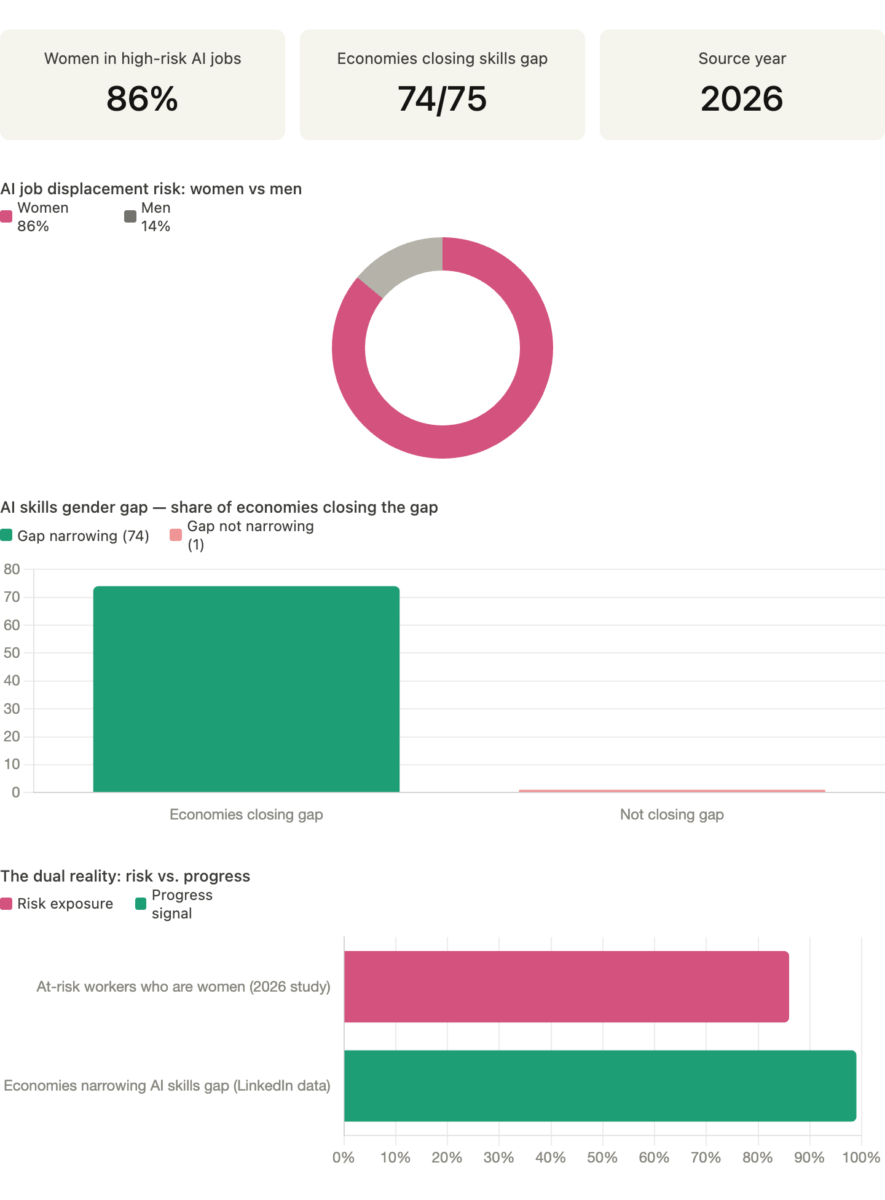
Data showcases a complex situation for professional women. On the one hand, a 2026 study found that women make up 86% of workers both highly exposed to AI job loss and least able to adapt to it. On the other hand, LinkedIn data shows that women are acquiring AI-related competencies at a meaningful pace, with the gender gap reducing in 74 of 75 economies.
So, how can women best safeguard themselves from future job uncertainty due to AI, and position themselves in the face of these tectonic changes?
Four Moves for Navigating AI Uncertainty
Across sectors, the women navigating this shift with the most confidence tend to share a few approaches. They:
1.Build AI fluency, even without a technical background.
According to the WEF’s Future of Jobs Report, 170 million new roles are projected globally by 2030, alongside 92 million displaced — a net gain driven by demand for people who can work with AI. AI literacy skills, such as prompt engineering and working critically with AI outputs are distinct from engineering skills, and they are becoming relevant across almost every field.
2.Invest in the skills AI cannot replicate.
McKinsey’s analysis finds that 72% of skills will support work done in collaboration between humans and AI. Complex judgment, cross-cultural communication, stakeholder relationships, and ethical reasoning are precisely the competencies that many women working in internationally diverse careers have built in depth. Organisations are increasingly struggling to find them.
3.Use networks with intention.
McKinsey’s Women in the Workplace 2025 report found that men receive more encouragement than women to use AI tools at work, particularly at entry level. Access to people who can share what tools they are using, which courses are worth doing, and how they are thinking about their own positioning is one of the most practical ways to close that gap. A mentoring relationship with someone a few steps ahead can make AI’s implications more accessible.
4.Document contributions in concrete terms.
As AI takes on more task execution, the ability to articulate impact — not just responsibilities but outcomes — becomes more important. This is already useful in performance and salary conversations, and it becomes more so as organisations rethink how roles are defined and valued.
Denmark’s Structural Advantage
A 2025 NBER study using Danish administrative data found that workers in AI-exposed roles are already transitioning into higher-paying positions where AI competencies are more relevant. The disruption is real, but so is the upward mobility for those who move with it.
The Danish government is actively promoting a culture of lifelong learning and continuous reskilling, with vocational programmes being redesigned to meet the demands of an AI-shaped labor market. That infrastructure is more developed here than in most European countries.
The conditions are in place to support the people ready to adapt. Reskilling support exists, the labor market is absorbing AI gradually rather than abruptly, and demand for human-AI collaborative roles is growing.
Forward-thinking organisations are already recognizing that the talent they most need for this transition — people who can work across complex, human contexts — is disproportionately found in groups they have historically underinvested in. For women looking to move, Denmark is not a bad place to do it.
Where to Go from Here
Knowing the landscape is one thing. Having people around you who are already navigating it is another. For many women, the barrier is not capability but exposure: access to the tools, the conversations, and the people that make AI feel navigable rather than overwhelming.
That gap closes fastest in communities. The women making confident moves in this shift are rarely doing it alone. They are doing it with mentors, peers, and networks that make the abstract feel actionable.
That is what ProWoc is built for. Become a member to connect to a community of women already working through these questions. The ProWoc mentoring programme pairs you with someone who has been where you are and can help you think through what comes next.