
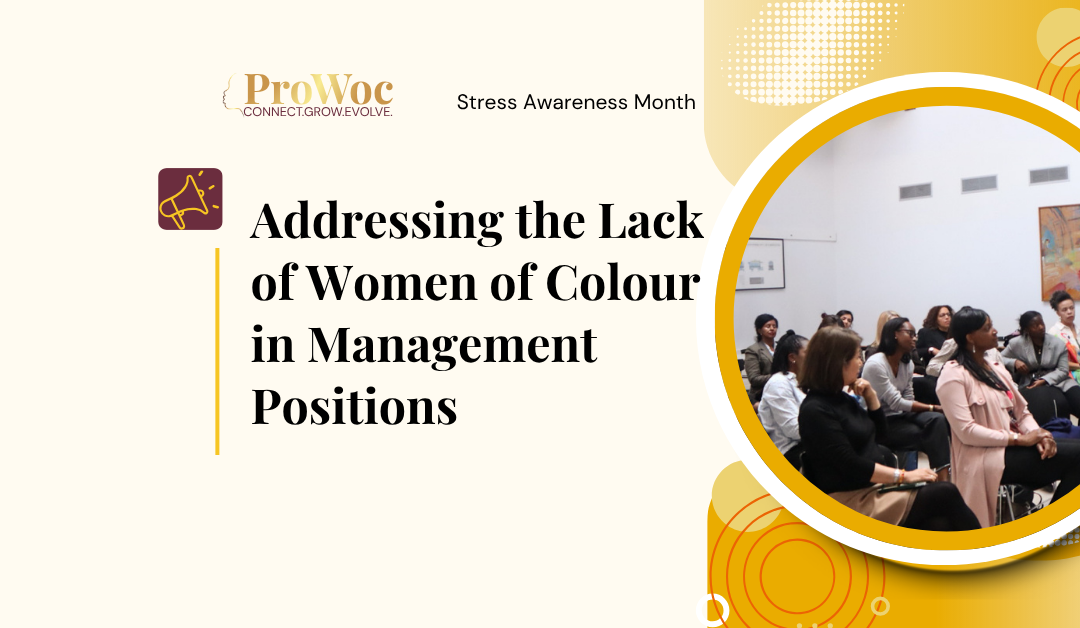
Most conversations about working women focus on the glass ceiling, the concept that refers to the invisible barrier that blocks professionals from reaching senior positions. But for women of colour, often, the first obstacle comes earlier than that, when they cannot become managers, due to work inequity. The term used to describe this situation is called the broken rung.
For over six years, ProWoc has worked alongside professional women of colour navigating Danish workplaces. We have seen, up close, that what holds talented professionals back is not a lack of ability, but a lack of access to the opportunities to grow. This article looks at how the broken rung shows up in Denmark, why it is so hard to measure, and what employers can do about it.
The Law That Protects Workers Also Erases WoC From the Data
Why data on WoC is invisible
Taking a closer look at how minorities or, indeed, how women of colour fare in the Danish workforce is surprisingly difficult. Studies like the EQUALIS Diversity Barometer – drawing on data from 3 million Danes – provide essential statistics on gender equality in the workforce, like the fact that the manager ratio is 0.45 women for every 100 men. But when it comes to the specific experience of non-Danish women, the data is minimal.
What the barometer uncovers is that non-Danish women fare worse across all five key areas it measures: career and education, working environment, labour market attachment, leadership and management, and income and assets.
The lack of data on women of colour is not an oversight, but a consequence of Danish law. Danish employment legislation explicitly prohibits employers from requesting, obtaining and using information about a worker’s race, skin colour, religion, or ethnic origin. Even voluntary, anonymised workplace surveys on ethnicity can be considered a breach of this rule.
The law was designed to protect workers from discrimination. In practice, it also makes it impossible to measure the gap between gender and ethnicity in the Danish workforce, and to track the career progression of non-Danish women.
What employers can do
Beyond Good Intentions: Structural Change That Actually Works
The broken rung is a structural problem, which requires structural solutions. Because of the Danish law, targeted measures for women of a specific demographic are not possible. But structural fairness is not a zero-sum game, improving conditions for all women can open doors for those facing greater barriers. The more women can advance into leadership, the more the conversation can expand to include those facing additional barriers.
Here are five actions employers can take to create more access to career advancing opportunities. This list can also be used as a tool for assessing the organisations you are part of or considering joining. A workplace that struggles with providing answers to most of these points may not be ready to support your growth.
1
Examine the promotion process.
- Promotion decisions should be traceable
- Who put someone forward, and on what basis?
- The same criteria should be applied across the board, independent of factors unrelated to work
Making the reasoning clear can reveal if the process is falling short.
2
Invest in mentoring and make it intentional.
- Mentoring gives professionals guidance and connections essential for career progression
- Research shows that mentors overly select mentees who resemble them in background, nationality and ethnicity. This creates a disadvantage for those who are already underrepresented
Intentional matching, where similarity is not centred in the mentorship choices, levels the playing field.
3
Create the conditions for safe reporting.
- A safe environment encourages more employees to report discrimination
- An open-door policy should be matched by the company culture, so that mixed messages are not sent
Sharing how the organisation has responded to past reports builds more trust than any written statement
4
Look at who is leaving and when.
- Underrepresentation at the manager level happens through a snowball of choices that blocks the pipeline
- Keeping an overview of who gets hired, who gets stretch assignments, and who gets introduced to the right people matters.
This legwork can uncover where diverse talent is lost along the way
5
Accountable leaders.
- Organisations that hold senior leaders accountable for diversity progress consistently outperform those where this is left to HR.
- Honest reporting, regular reviews and goals with named ownership foster change.
Without this accountability, inclusion efforts rarely last over time.
ProWoc works with organisations across Denmark to build more inclusive workplaces. If your company is ready to move from intention to action, find out more about ProWoc’s sponsorship program. You can also explore how ProWoc’s mentoring programme supports women of colour in navigating the early career pipeline, and join us at one of our upcoming events to hear directly from the leaders doing this work.
Stress awarness month
Part 2 of our April series:
Empowering women to rise and lead begins with recognizing their inherent strength, potential, and capability to shape the world around them. When women are given opportunities.
Blog
ProWoc Volunteer of the Year 2021
ProWoc's volunteers are like the central nervous system as they make us, as a network tick. Our...
ProWoc Impact Award Recipient for 2021
At ProWoc we firmly believe in the power of role modelling and we celebrate those who lead and...
Introducing the recipient of the ProWoc Congeniality Award
Anyone who has attended a ProWoc event can attest to the warm welcome and openness from Sue-Angel....